Generative AI VS Agentic AI: What is the Difference?
Published On: 31 Aug 2026
Last Updated: 31 Aug 2026
About the Author
DataSpace Academy
DataSpace Academy is a leading Edtech offering career-focused courses like Cyber Security, Data Analytics, Digital Marketing, Data Science, AI with 100% Placement Assistance.
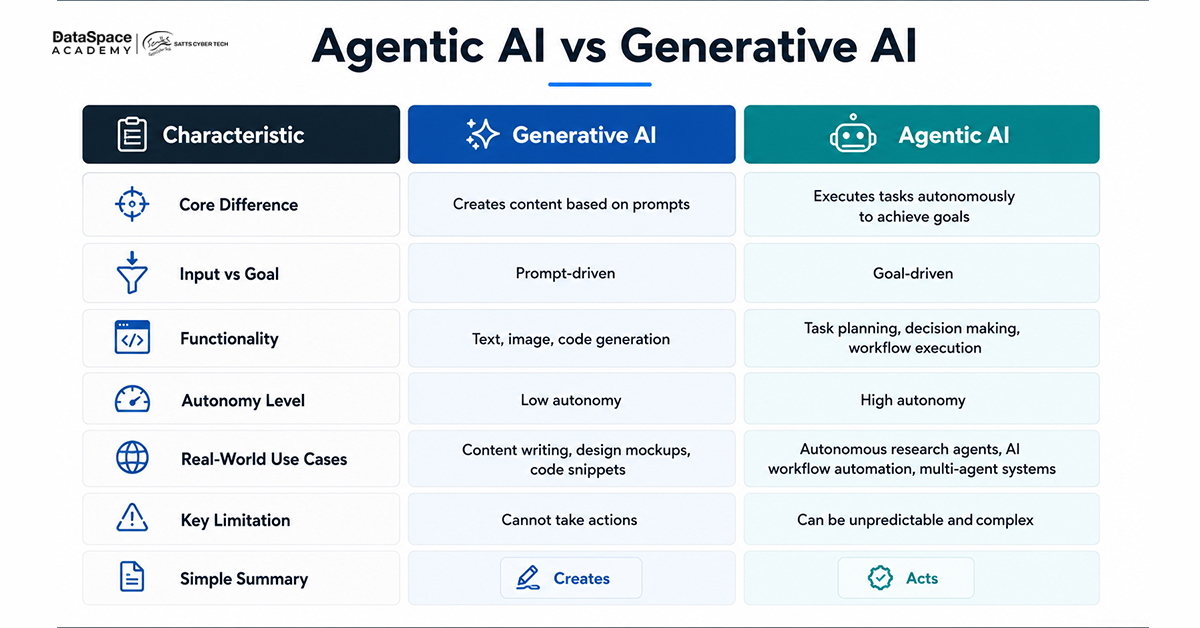
Currently, we can see an important shift in businesses' approach where the use of Artificial Intelligence has increased. This has also led to understanding the aspect of Generative AI vs Agentic AI for better business proceedings. Generative AI creates content from prompts, while agentic AI plans, decides and executes multi tasks. Understanding the difference helps professionals choose the right technology, build practical skills and prepare for an evolving AI-driven workplace.
Introduction
Artificial Intelligence has moved far beyondsimple chatbots. Today, businesses use AI for content creation, research, analytics, coding and decision-making. As these applications grow, two concepts have gained significant attention, Generative AI vs Agentic AI. Although both technologies use advanced AI models, they solve problems in different ways. Generative AI primarily creates or transforms information, while Agentic AI focuses on achieving a goal through a series of actions. Understanding these differences matters because businesses do not always need the most advanced AI system. They need the right system for the right problem. Well, let’s understand in this blog the difference between Generative AI vs Agentic AI.
What is Generative AI?
Generative AI creates new content by responding to prompts and instructions. It can produce text, image, code, videos and other forms of content. For example, a marketer can ask a generative AI tool to:
Write a product description
Create a social media caption
Summarize a report
Generate an image concept
Draft an email
Create a code snippet
Develop content ideas
The user generally provides the direction, reviews the output and decides what happens next. Therefore, generative AI works particularly well when the primary requirement involves creation, ideation, or transformation of information.
What is Agentic AI?
Agentic AI takes the concept further. Instead of simply responding to an individual prompt, it can pursue a defined objective through multiple steps. An agentic system can:
Understand a goal
Break the goal into smaller tasks
Plan a sequence of actions
Use external tools or applications
Evaluate results
Adjust its approach
Continue until it reaches a defined outcome
For instance, consider a sales reporting task. A Generative AI tool can create a sales report when you provide the relevant data and instructions. An agentic system could potentially retrieve the data, analyze it and identify unusual changes and send it to the appropriate team according to predefined permission and rules.
Generative AI vs Agentic AI Technology: What Separates Them?
The simplest way to separate Generative AI vs Agentic AI Technology distinction is to look at their approach to work. Generative AI
Responds to prompts
Produces content
Supports individual tasks
Depends more heavily on user direction
Works well for creative and knowledge-based assistance
Agentic AI
Works toward a goal
Plans multiple steps
Uses tools and external systems
Makes decisions within defined boundaries
Can adapt based on results
Automates broader workflows
However, these technologies do not necessarily compete with each other. In a practical system, Generative AI provides reasoning or content generation capability while an agentic framework adds planning, memory, tool and action.
Generative AI Content Creation vs Agentic AI
The difference becomes even clearer when we look at marketing. With Generative AI Content Creation vs Agentic AI a generative system might write a blog outline, create social media captions or develop an email campaign. An agentic workflow could take a broader objective such as:“Prepare and manage this month's content campaign.” The system could potentially research topics. Organize content ideas, organize content data, schedule tasks through connected platforms and recommended changes based on predefined rules. Human supervision still matters, especially when a system can make changes in external platforms. Businesses need appropriate permissions, validation steps, monitoring, and clear boundaries before allowing autonomous systems to take consequential actions.
Generative AI vs Agentic AI in Data Analytics
The distinction also matters in analytics. Generative AI vs Agentic AI in Data Analytics can look like this. Generative AI can help analysts:
Explain a dataset
Generate SQL queries
Summarize dashboard findings
Suggest analytical approaches
Create report drafts
Explain complex results
Agentic AI can potentially:
Collect information from multiple systems
Run a sequence of analytical tasks
Detect unusual patterns
Compare results against predefined benchmarks
Generate reports
Trigger follow-up workflows
For example, an analyst could ask Generative AI to explain why sales declined. An agentic workflow could retrieve relevant sales, marketing data and prepare an analysis for review. This distinction shows why professionals increasingly need more than basic prompting skills.Thus, making them look for Generative AI Course in Kolkata.
Where Does Each Technology Work Best?
Choosing between them depends on the business requirements. Choose Generative AI when you need:
Content creation
Brainstorming
Summarization
Translation
Image generation
Coding assistance
Document analysis
Consider Agentic AI when you need:
Workflow automation
Multi-step research
Repetitive operational processes
Cross-platform task execution
Automated monitoring
Goal-based decision support
What Does Generative AI vs Agentic AI Future Look Like?
The Generative AI vs Agentic AI Future will likely focus less on choosing one technology and more on combining their strengths. Generative AI can create the content while an agentic system can connect those stages into a larger workflow. Let’s take an example: Research → Analysis → Content Creation → Review → Distribution → Performance Monitoring A future AI workflow could support several of these stages while humans continue to define objectives, approve important decisions and monitor outcomes. The rise of the agentic system also makes governance more important because greater autonomy creates greater consequences.
Why Should Professionals Learn Both?
AI skills now extend beyond knowing how to write effective prompts. Professionals can benefit from understanding how AI models, tools, workflows and automation systems work together. A structured learning environment can help learners understand.
In this respect, institutes like DataSpace Academy help learners explore practical AI concepts through industry-oriented training and hands-on learning. It focuses on applied skills that can help professionals understand how modern AI technologies fit into real business workflows. Their Generative AI Course: Python to Production AI course helps the learners to get more career opportunities.
Conclusion
The key difference in Generative AI vs Agentic AI comes down to create versus action. Generative AI creates content and assists users with specific tasks. Agentic AI goes further by pursuing goals, planning multiple steps and executing workflow with greater autonomy. As AI continues to evolve, professionals who understand both technologies can make better decisions about where to automate, where to create and where human judgment must remain involved. Moreover, DataSpace Academy can help aspiring professionals build practical AI knowledge and understand how these technologies can support modern careers. So, are you ready to build practical AI skills for the next generation of work? Start learning with DataSpace Academy. Thus, making the learners to be in the race of getting Top AI Careers in 2026.
FAQs
What is the main difference between Generative AI and Agentic AI?
Generative AI creates outputs from prompts, while agentic AI plans and executes multi-step tasks to achieve defined goals.
Is Agentic AI built on Generative AI?
Many agentic systems use generative AI models as reasoning or content-generation components alongside planning, memory, tools and control mechanisms.
Which technology works better for content creation?
Generative AI generally works better for drafting, brainstorming, summarizing and producing text, images, code, or other content.
Can businesses use Generative AI and Agentic AI together?
Yes, businesses can combine generative capabilities with agentic workflows to create and execute larger end-to-end processes.
How can professionals prepare for the future of AI?
Professionals should learn generative AI fundamentals, prompting, automation, AI tools, workflow design and responsible AI practices.