DataSpace Academy is a leading Edtech offering career-focused courses like Cyber Security, Data Analytics, Digital Marketing, Data Science, AI with 100% Placement Assistance.
Large Language Models (LLMs) power many modern generative AI applications, from chatboats and content creation to coding and research. Understanding what is an LLM helps beginners learn how models process tokens, recognize language patterns and generate responses. This guide explains LLMs, Transformer architecture, training, applications, limitations, and practical steps for starting a career in generative AI.
Introduction
Artificial Intelligence has changed the way people search for information, write content, analyze data, create software and communicate with technology. Behind many of these technologies, you will find a powerful technology called a Large Language Model (LLM). But what is an LLM and can it understand a question and generate a meaningful response within seconds? An LLM is a type of AI model trained on massive amounts of data to understand and generate language. Modern LLMs can support tasks such as text generation, translation and question and answering. Google Cloud explains that LLMs typically use deep learning architectures such as Transformers and train on billions of pieces of text and other content.Understanding how LLMs work can help students, professionals, and business owners make better decisions about generative AI.
What is an LLM?
An LLM or Large Language Model, is a machine learning model that learns patterns in language from an extremely dataset. Instead of storing a simple list of answers an LLM learns relationships between words, phrases, concepts and contexts. When you provide a prompt, the model proposes the available context and predicts what tokens should come next. For example, if you enter:“The capital of France is…” The model identifies the relationship between the words and generates “Paris” as the likely continuation.The same underlying principle allows LLMs to perform much more complex tasks like:
Writing and rewriting content
Summarising long documents
Answering questions
Translating languages
Generating and explaining code
Creating conversational responses
Extracting information from text
Google cloud also highlights text generation, machine translation, summarisation and chatbots among common LLM applications. In this pattern LLM is Explained for Beginners and makes sure that the beginnerscan grasp more knowledge.
How Does an LLM Work?
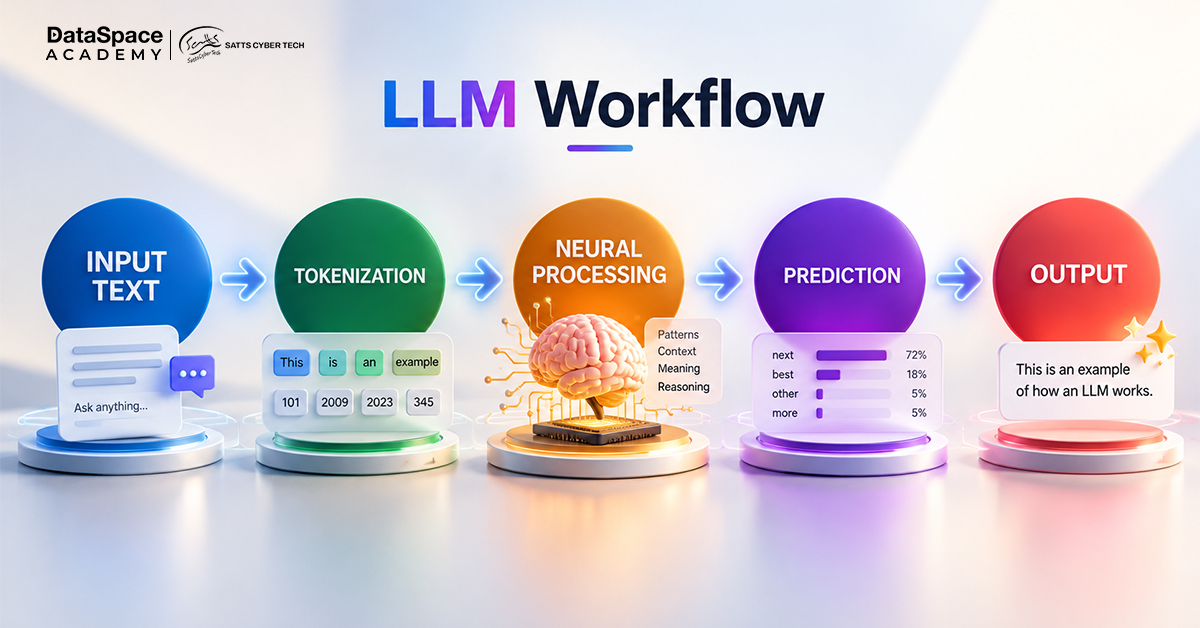
An LLM may appear to “understand” language like a person, but it actually uses mathematical patterns learned during training. The process involves several important stages.
Data Collection and Preparation
Developers train LLMs using enormous datasets containing text and depending on the model. The training data can contain sources such as:
Books and articles
Websites
Documentation
Research material
Publicly available text
Programming code
Developers then prepare the data so the model can process it effectively.
Model Training
During training, the model learns statistical relationships within the data. A simplified example looks like this: “Data analysts use SQL to…” The model learns that words such as query, analyse, retrieve or work with databases can logically follow the sentence based on the pattern it encountered during training. The model repeats this process across an enormous amount of training data and gradually develops the ability to predict language patterns. Google Cloud describes LLMs as statistical language models trained on massive amounts of data and notes that they commonly rely on deep learning architecture such as transformers.
What Is a Transformer in an LLM?
The transformer architecture plays a central role in many LLMs models. Google researchers introduced the Transformer architecture in 2017. It uses mechanisms such as self-attention to determine which parts of the input deserve more attention when processing language.For example, consider this sentence:“The student placed the book on the table because it was heavy.”To interpret the sentence effectively, the model needs to understand what “it” refers to. Attention mechanism helps the model examine relationships between words across the context. The ability to process relationships within context helps Transformers handle long and complex sequences more effectively than many earlier approaches.
How Does an LLM Generate an Answer?
After training an LLM can process a user’s prompt and generate a response one token at a time. Consider the prompt:“Explain data analytics in simple words.”The model analyses the prompt, considers the context and predicts a suitable sequence of tokens. It continues this process until it produces a complete response. The important part is that an LLM does not simply search a database and copy an existing answer. It generates a response based on pattern and relationships learned during training and the context provided in the prompt. That capability makes LLMs highly flexible across different tasks.
Why Are LLMs Important for Generative AI?
LLMs provide much of the language-generation capability behind modern generative AI applications. Businesses can use LLM-powered applications for:
Customer support
Content assistance
Document summarisation
Knowledge management
Software development
Research assistance
Data interpretation
Workflow automation
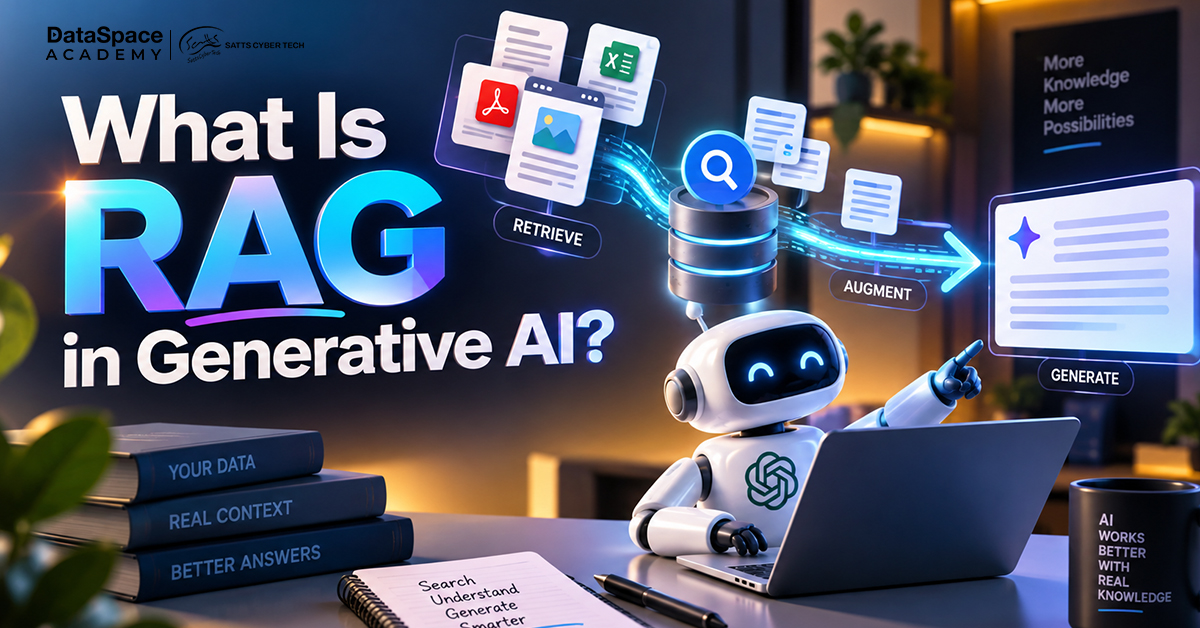
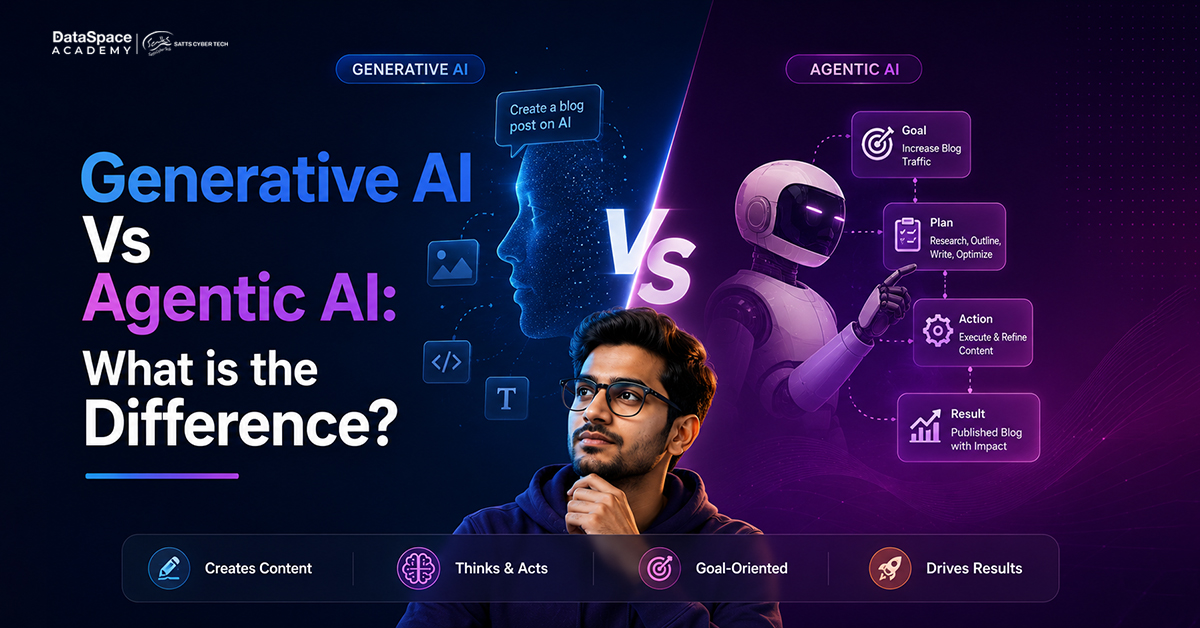
For instance, a company can build an internal AI assistant that employees search documentation, summarize reports or answer common operational questions. LLM can work with additional systems such as retrieval pipeline, database and AI agents.
What Are the Limitations of LLMs?
Despite their capabilities, LLMs do not guarantee that every generated answer will be correct. An LLM can produce a confident response that combines inaccurate information. Developers often describe these incorrectly generated responses as hallucinations.Other challenges include:
Bias within training data
Outdated information
High computing requirements
Context limitations
Data privacy concerns
Inconsistent responses
Therefore, businesses should evaluate AI outputs carefully, especially when applications support important decisions.
How Can Beginners Start Learning LLMs?
You do not need to become an AI researcher before you start learning about LLMs. A structured learning path can help you understand the technology progressively. LLM is Explained for Beginners in the below mentioned aspects.Start with:
For learners looking for structured guidance, DataSpace Academy provides Generative AI- focused training that helps connect foundational concepts with practical application. Building projects alongside your learning can help you understand how LLMs work outside theoretical examples. If you are searching for Generative AI Course in Kolkata focus on programs that teach more than prompt writing. Look for practical exposure to Python, LLMs, APIs, RAG and AI framework.
Conclusion
Learning what is an LLM gives you a foundation for understanding much of today’s generative AI ecosystem. LLMs learn language patterns from massive datasets, process prompts through architecture such as transformers and generate response by predicting sequence of tokens. Their applications now extend across writing, coding, customer service and AI-Powered business solutions. If you want to develop industry-relevant skills, a structured Generative AI Course in Kolkata can help you progress from foundational concepts to building real-world LLM applications. So, start your Generative AI journey with DataSpace Academy and learn how to build practical LLM-powered applications.
FAQs
What is an LLM in simple terms?
An LLM is an AI model that learns language patterns from large datasets and generates human-like text.
How does an LLM generate responses?
An LLM processes a prompt and predicts the most suitable sequence of tokens to create a response.
What is the role of Transformers in LLMs?
Transformers use attention mechanisms to understand relationships between different parts of text and process language efficiently.
Can beginners learn LLM technology?
Yes, beginners can start with Python, machine learning, NLP, prompt engineering, APIs, and practical LLM projects.
5. Where are LLMs used today?
LLMs support chatbots, content creation, coding, summarisation, research, customer service, document analysis, and AI-powered applications.