Choosing data science as a career in 2026 is a smart move to accelerate your professional graph, only if you know how to get started in a structured way. The tech landscape today is rapidly evolving, requiring modern data science professionals to be equipped with skills and proficiency in programming languages as a critical credential for delivering high impact projects.
With industries demanding job-ready professionals, structured learning becomes essential. While the journey may seem overwhelming at first, joining the
best data science training institute Kolkata can provide the right guidance, structure, and confidence. This guide explores the top programming languages you need to succeed in data science in 2026. Let’s begin.
Proficiency in programming languages is a core skill for data science professionals, essential to manage, analyse, and visualise data efficiently from complex datasets. Without programming languages, the process would be time consuming, difficult to expand, and resource-draining.
Here are the top benefits of programming languages that are indispensable in data science:
Knowledge and skill in programming languages are essential in the data science industry for their versatile applications across web development, statistical computing, deep learning, data analysis, and much more.
If you are passionate about making it big in the data science industry, it is essential to master some of the most frequently used programming languages in data science:
Python tops the list as the undisputed programming language because of its simplicity, flexibility, and sprawling libraries. This degree of adaptability makes Python imperative for AI, ML, data analysis, and backend development across startups and large companies.
Additionally, its simple and readable syntax reduces the learning curve, making it a go-to choice among beginners. Due to this unmatched adaptability, Python ranks as one of the best programming languages for data science.
R is often referred to as the statistical powerhouse, designed specifically for statistical computing and data visualisation. The language is extensively used in exploratory data analysis, hypothesis testing, and visual storytelling with packages like ggplot2 and dplyr.
Its extensive statistical capabilities make it an ideal choice for deep statistical analysis and publication-ready charts.
While not a general-purpose language like Python, SQL (Structured Query Language) is indispensable for data scientists. It is the backbone of querying and managing data stored in relational databases.
SQL enables professionals to extract, filter, and prepare data efficiently before analysis. Mastery of SQL significantly boosts your ability to work with real business datasets.
Java remains a key language in large-scale data environments, especially in systems that demand strong performance and reliability. It integrates seamlessly with big data tools like Hadoop and Spark.
This makes Java highly valuable for handling data pipelines and production-grade systems where speed and scalability are critical.
Julia is gaining significant attention among data enthusiasts for high-performance numerical computing. Designed to handle large datasets with fast execution speeds, it combines ease of use with high performance.
Though its ecosystem is still growing, Julia is increasingly relevant in scientific computing and performance-centric analytics tasks.
Scala runs on the Java Virtual Machine (JVM) and pairs naturally with Apache Spark, making it one of the most powerful languages for big data analytics.
Its functional programming approach helps manage distributed computing tasks and large datasets efficiently, making it a top choice for real-world data workloads.
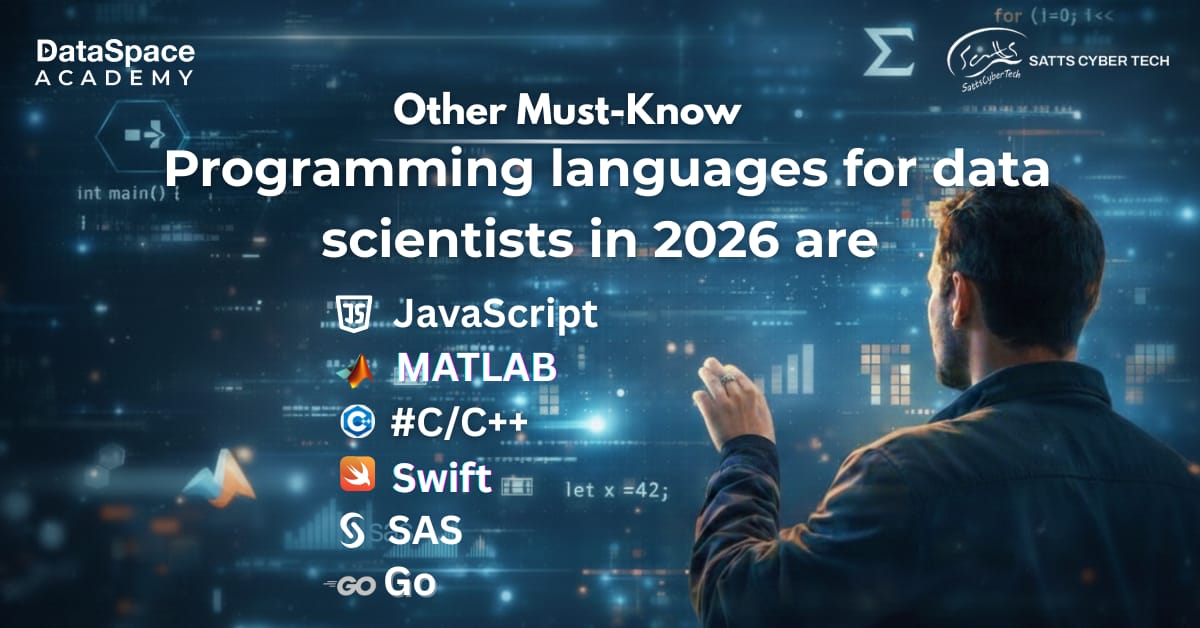
Wondering where and how to begin your structured learning journey? Get started by enrolling in the
best data science course Kolkata and upskill through expert-led sessions, real-world applications, and capstone projects aligned with your career goals.
Are you ready to accelerate your data science career in 2026? Stay ahead of the competition by joining a
data science training institute Kolkata to learn the latest industry trends, real-world applications of programming languages, and in-demand skills.
Don’t delay your professional growth—take the first step today and unlock new career opportunities.
visit us for more details.
Python is the best language to start with due to its simple syntax, vast libraries, and strong applications in AI, ML, and data analysis. It is beginner-friendly and widely used across industries.
Yes, SQL is essential for working with real-world business data. It helps data scientists extract, manage, and prepare data stored in relational databases before analysis.
Not necessarily at the beginning. Start with Python or R, and gradually learn others like Scala or Julia based on your project requirements and career goals.
Structured training provides expert mentorship, real-world projects, and practical exposure that help you master programming languages efficiently and become industry-ready.


 Loading...