Have you ever spent an entire day testing different machine learning models only to realise that a small parameter change affected the results? This situation is common in traditional data science projects. Many professionals estimate that nearly
75% of their time goes into data cleaning, feature engineering, and model experimentation, while only
25% focuses on extracting insights from data. This challenge is exactly where the
AutoML workflow is beginning to reshape modern data science practices.
Initially, data science teams handled every step manually. They cleaned datasets, engineered features, selected algorithms, and tuned models one by one. This process required significant time and deep technical knowledge. However, as data volumes increased, the need for automation became more evident. Today,
automated machine learning platforms help analysts build models faster while maintaining strong predictive performance.
So, in this blog, let us explore
how AutoML changes data science workflows in 2026.
Automated Machine Learning (AutoML) is the process of automating the end-to-end application of machine learning. A traditional machine learning workflow requires making several technical decisions, such as:
The introduction of AutoML simplifies these processes by automating many of these decisions and accelerating model development.
The
AutoML workflow automates multiple stages of the machine learning pipeline. These stages typically include:
Automated systems test multiple models and automatically select the best-performing one.
In traditional machine learning workflows, data scientists often experiment with several algorithms such as
Random Forest, Support Vector Machines, and Gradient Boosting. Each of these models requires proper validation and tuning. AutoML platforms run these experiments automatically and deliver optimised results.
For example, a retail company predicting customer purchase behaviour may test several models manually, which could take days. An AutoML system, however, can test
20 to 50 model combinations within minutes and recommend the most accurate solution.
An automated machine learning process follows a structured pipeline where each stage focuses on improving reliability and predictive performance.
Typical AutoML stages include:
These steps create a streamlined data science pipeline. Automation removes repetitive coding tasks and accelerates experimentation.
Understanding the difference between traditional machine learning and AutoML helps explain why automation is becoming essential in modern analytics.
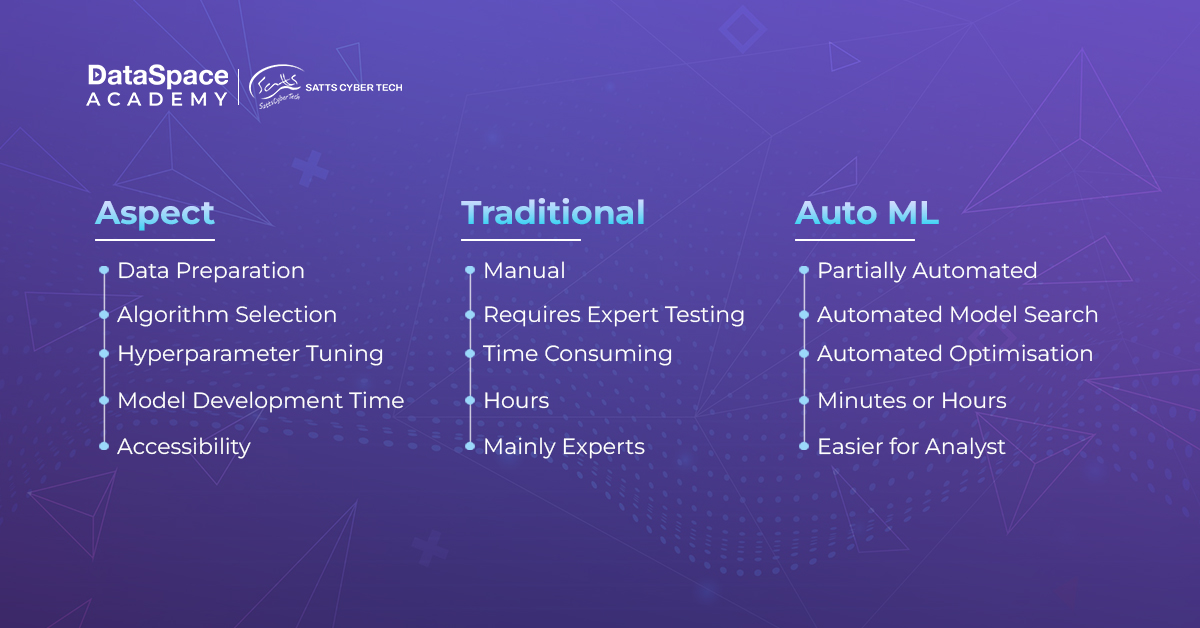
This comparison clearly shows how automation simplifies complex processes. Data teams can focus more on interpreting results rather than building models from scratch.
Automation brings several advantages to modern analytical teams. These benefits explain why organisations increasingly adopt automated machine learning platforms.
Key benefits include:
AutoML also improves productivity. Teams can test multiple algorithms simultaneously instead of running experiments sequentially. According to industry reports, organisations using automated machine learning tools experience up to
35% faster deployment of predictive models.
ML automation tools simplify complex machine learning tasks. They support feature selection, generate detailed performance reports, and provide evaluation metrics for models.
Popular automation platforms such as
Google AutoML and
H2O.ai evaluate multiple algorithms and recommend the best-performing models.
Automation also improves reproducibility. Every experiment is recorded along with configuration details, allowing data teams to revisit experiments and refine models later.
After learning the fundamentals, many learners explore professional training programs. Institutes such as
DataSpace Academy introduce students to modern automation platforms used by data science teams and help them develop industry-ready programming and analytical skills.
Automation does not eliminate the need for data scientists. Instead, it shifts their focus toward problem-solving and strategic analysis. Professionals now spend more time designing analytical strategies rather than performing repetitive coding tasks.
Students interested in analytics often choose structured learning programs to develop their skills. Many learners opt for a
data science course in Kolkata with placement to gain practical experience in machine learning and data analysis.
Training programs usually cover:
Institutes like
DataSpace Academy provide hands-on exposure to real industry tools, preparing students for practical roles in machine learning teams.
Automation will continue to transform the analytics industry. Experts expect
automated machine learning to become a standard feature in data platforms by 2026. Businesses will increasingly integrate automation into their business intelligence systems.
However, human expertise will remain essential. Automated systems can generate models, but professionals interpret results and guide strategic decisions.
The
AutoML workflow therefore supports data scientists rather than replacing them. Organisations will combine automation with human insight to create faster and more reliable data-driven decision-making systems.
Learning these technologies is becoming essential for future professionals. Institutes such as
DataSpace Academy help learners build strong foundations in modern analytics and machine learning tools.
Automation is reshaping modern analytical practices. The
AutoML workflow simplifies model development, speeds experimentation, and improves predictive accuracy.
Businesses are rapidly adopting automated machine learning platforms to manage complex data challenges. Learners who want to enter this field can build strong careers through structured training, such as a
data science course in Kolkata that focuses on automation-driven data science.
Start exploring automated machine learning tasks like
model selection and feature engineering to prepare for the future of data science.
AutoML automates machine learning tasks such as model selection, feature engineering, and hyperparameter tuning, making the development process faster and more efficient.
No. AutoML supports professionals by automating repetitive tasks while data scientists focus on insights, strategy, and decision-making.
Industries such as finance, healthcare, e-commerce, and technology widely use automated machine learning systems.
Yes. Many automation tools offer visual interfaces and guided workflows that make experimentation easier for beginners.
Automation is becoming central to modern analytics workflows, making AutoML knowledge valuable for future data science careers.


 Loading...