SEO in 2026 has evolved drastically and rapidly in the last two decades- from beyond keywords, link building, and guest posting to today’s automated-personalised strategies like AEO and GEO. In today’s current digital landscape, search optimization has evolved to be the silent accelerator of digital growth. With global
SEO investments projected to reach $143.9 billion by 2030, professionals and beginners are increasingly curious about SEO career scope in 2026. Let’s explore what 2026 has in store for the aspiring digital marketers and seasoned professionals as well.
Before going any further, let’s get the basics right to understand if SEO still worth learning in 2026. Precisely speaking, SEO is beyond just chasing algorithms. The ultimate intent of a comprehensive SEO strategy is to guide searchers exploring answers that actually match their search intent. As long as people continue to search online, search engines will continue to evolve to meet specific search intent, and hence optimization will stay relevant this year, next, and beyond.
Even in 2026, while search shifts toward voice, visuals, and AI assistants, the ‘intent’ remains the same. And that’s what defines SEO in the perfect sense- to understand what people want and feature it in the most efficient ways. That’s why SEO career scope in 2026 continues to be a sustainable and thriving career choice in the dynamic and competitive job landscape.
The Evolution of SEO: From Keywords to Context
Gone are the days when SEO was all about mindless keywords stuffing to manipulate algorithms, buying shady links, and other dubious marketing tactics. SEO in 2026 is a more contextual, multi-disciplinary field, powered by Google’s ever-evolving AI integration that is exceptional at understanding context, user satisfaction, and most importantly users’ search intent.
If you are passionate about starting out in 2026, this is a great time to master concepts that can proactively assist your career advancement in the dynamic digital landscape. Such as:
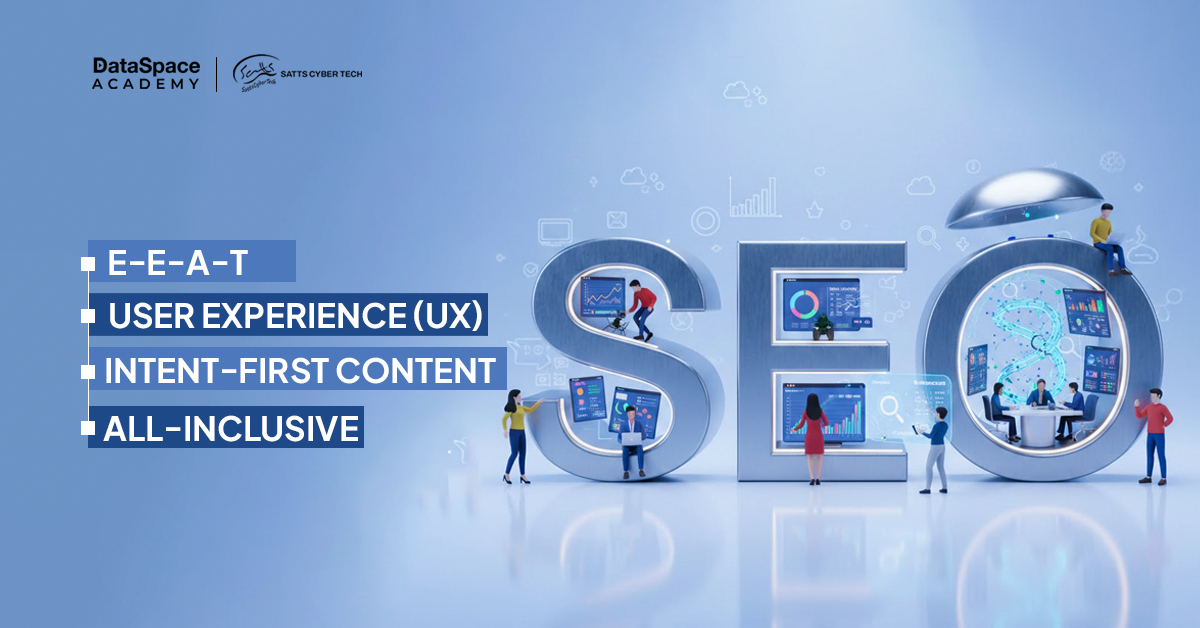 E-E-A-T (Experience, Expertise, Authoritativeness, Trustworthiness):
 Your content must offer authoritativeness to audiences, so they find it reliable as an expert-written informative piece.
User Experience (UX): How fast does your page load on desktop and laptop? Is it easy to access and navigate on the phone? Do people stay longer and engage or leave immediately? All these are vital factors that directly impact your SEO performance.
Intent-First Content: Purpose-driven content is the differentiator between you and other brands. Remember, every year Google releases Core Updates that emphasize on human-first, intent-focused content to serve searchers’ intent otherwise get penalized.
All-Inclusive: Remember, SEO for beginners in 2026 has expanded far beyond organic rankings in search engines. Modern SEO is now an integral part of content marketing, social platforms, ad marketing, public relations, and even branding strategy as well.
For anyone planning to start out in digital marketing in 2026, must know that SEO is less about chasing clicks and more about building real connections with the audience, understanding data, crafting human-first content, and assessing how users think and behave.
With AI rapidly transforming the marketing dynamics, it’s obvious to wonder if SEO roles are at risk. The promising news is AI and SEO have already teamed up to accelerate growth with data-driven precision, but AI cannot:
In 2026 and beyond, the most valuable skill in SEO is to yield AI in the most efficient ways for data-driven decision-making, instead of being an obsolete team addition.
So, how does an SEO career looks like in 2026 majorly depends on the current landscapes, which offers:
Begin your SEO journey by learning from popular online platforms on Google, YouTube, and free webinars organized by reputed learning platforms. Enrich your knowledge by understanding the four pillars that drive rankings: technical SEO, on-page optimization, authority building, and content relevance. For a structured, future-ready approach, enrolling in a
digital marketing course with AI can clearly set you apart.
Get hands-on with Google Search Console and GA4. Additionally, explore AI writing assistants and SEO platforms like Ahrefs, MailChimp, Canva, and SEMrush to see how smart tools can reshape your project performance and outcomes.
Practice is your biggest advantage. Begin with writing keyword-focused SEO blogs, experiment with guest posts, optimize social profiles, or improve a small business website by expanding both online and offline networks.
From technical SEO to content-led strategies or local business optimization- choosing a specific specialization helps you stand out. Discover what adds to your strengths and build depth there.
The most valuable marketers aren’t just skilled- adaptation is the permanent key to stay relevant. Keep learning, stay active in the SEO community, evolve with every algorithm update, and most importantly improve your
communication skills to stay future-ready.
So, is SEO still worth learning in 2026?
As you can see, we have provided sufficient fact and number-backed evidence to confirm that SEO is here to stay. If you’re curious about how people actually search, prefer data-driven decisions, and enjoy blending creativity with technology, then yes- SEO is absolutely for you. Plus, beginners who embrace AI-powered workflows early will always have an added advantage in visibility during job interviews and project performance.
No, AI will not replace SEO specialists. Instead, it will automate repetitive tasks, allowing SEOs to focus more on high-level strategy, creative content planning, user experience analysis, and interpreting AI-generated insights.
Unlike paid advertising, SEO is a long-term organic strategy. It typically takes 4 to 12 months to see significant traction in competitive areas, depending on the website’s authority, competition, and consistency of effort.
Beyond traditional keyword and link-building knowledge, modern SEO skills include understanding AI and how to prompt it effectively, data analysis (especially in GA4), user experience (UX) and Core Web Vitals, content marketing for E-E-A-T, and technical SEO fundamentals for site structure and crawling.
This isn’t an either/or choice. The most effective digital marketers understand both. SEO builds a sustainable, long-term asset (organic traffic) that works 24/7 without direct ad spend, whereas paid ads offer immediate, targeted traffic.
Yes, you can learn the fundamentals of SEO for free through extensive online resources. While industry-recognized certifications can provide structured learning and validate your knowledge to employers.

 Loading...