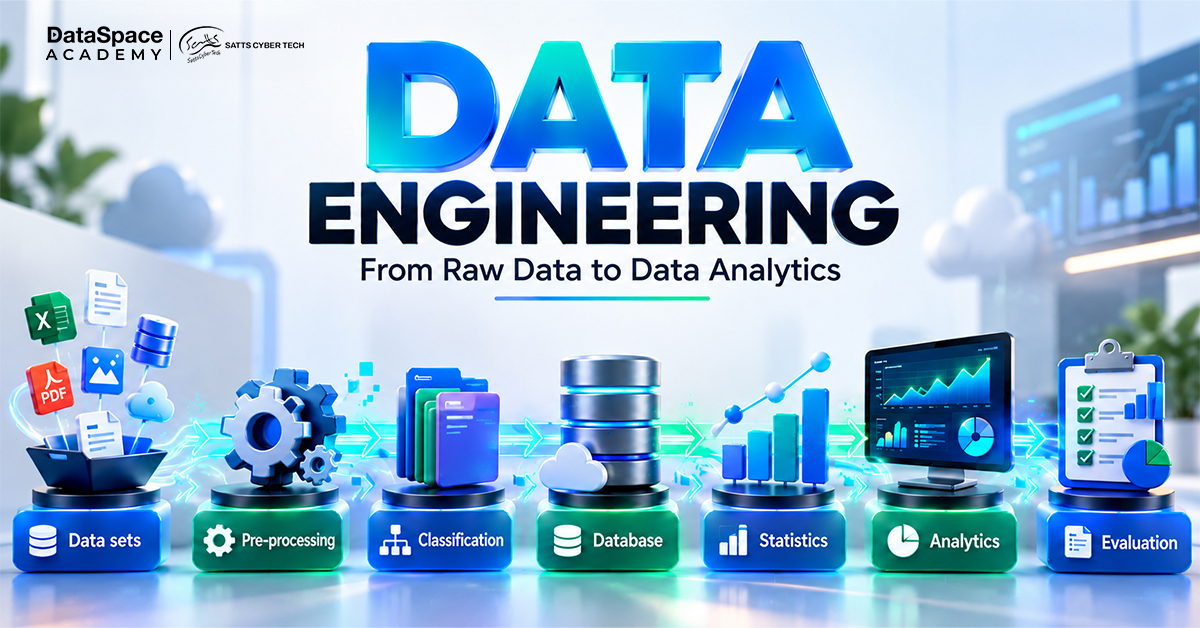
What Is Data Engineering? From Raw Data to Data Analytics
Published On: 09 Oct 2026
Last Updated: 09 Oct 2026
5 min read

About the Author
DataSpace Academy
DataSpace Academy is a leading Edtech offering career-focused courses like Cyber Security, Data Analytics, Digital Marketing, Data Science, AI with 100% Placement Assistance.
Businesses generate a huge volume of data every day, but raw information alone cannot support better decisions. Data Engineering transforms raw data into clean and accessible data sets for analytics, reporting and AI. This guide explains key processes, essential data engineer skills, career opportunities, and a practical roadmap for building a successful career in this growing field.
Introduction
Every business generates data. Customer transactions, website activity, payments, social media interactions and operational systems create information every day. However, raw data has limited value when businesses cannot collect, organise, process, and access it efficiently. This is where Data Engineering becomes important. Well, India has a growing demand for professionals who can build and manage modern data systems. As a current market indicator, LinkedIn lists 11,000+ Data Engineer job openings in India, showing the scale of hiring activity for this role. So, what exactly does a data engineer do? How does data engineering connect raw information with data analytics? And what skills do you need to enter this field? Let’s understand the journey in this blog.
What is Data Engineering?
Data Engineering focuses on collecting, storing data, transforming and delivering data so that organizations can use it effectively. A data engineer builds the system that move data from different sources into accessible platforms. For instance, an e-commerce company may collect thousands of transactions every day. A data engineer can build a pipeline that collects this information, cleans it, stores it in a data warehouse, and makes it available for analysis. Therefore data engineers create the foundation of data-driven decision making.
How Does Data Move From Raw Data to Analytics?
The journey usually involves several important stages.
Data Collection
Businesses collect information from websites, applications, databases, APIs, CRM systems, IoT devices, and other sources.
Data Ingestion
Data engineers move information from these sources into storage systems. They may use batch processing for scheduled data or streaming systems for real-time information.
Data Cleaning
Raw data often contains missing values, duplicates, incorrect formats, or inconsistent records. Data engineers clean and transform the information before further use.
Data Storage
Engineers store processed data in databases, data warehouses, or data lakes based on business requirements.
Data Transformation
They convert raw information into structured datasets that teams can easily analyse.
Data Analytics
Finally, analysts use these prepared datasets to create reports, dashboards, identify trends, and support business decisions.
Why is Data Engineer Important?
Modern organisation makes decisions based on data. However poor quality can lead to incorrect conclusions. Strong data engineer helps business
Build reliable data pipelines
Improve data quality
Reduce manual data preparation
Support real-time analytics
Manage large datasets
Improve reporting
Support AI and machine learning
Create a single source of reliable information
Moreover, the growth of AI has increased the importance of good data infrastructure. AI systems need organized and trustworthy data to deliver useful results.
Data Engineer Skills
A data engineer needs a combination of programming, database, cloud and problem-solving skills. Important data engineer skills include:
SQL
Python
Database management
Data structures
ETL and ELT
Data warehousing
Data pipelines
Cloud platforms
APIs
Data modelling
Version control
Basic understanding of data analytics
Data Engineering Roadmap for Beginners
Step 1: Learn programming fundamentals, especially Python.
Step 2: Build strong SQL and database skills.
Step 3: Understand data structures and data modelling.
Step 4: Learn ETL, ELT and data pipeline concepts.
Step 5: Explore data warehouses and data lakes.
Step 6: Learn cloud platforms such as AWS, Microsoft Azure or Google Cloud.
Step 7: Practise with tools such as Apache Spark.
Step 8: Build practical projects that demonstrate your skills.
Learn Data Analytics Alongside Data Engineering
You do not always need to become a data engineer to benefit from these skills. If your goals involve analyzing business data, learning how data moves through databases and pipelines can improve your overall understanding. A structured Data Analytics Course in Kolkata can help learners build skills in SQL, Python, Excel, Power BI, data visualisation, and AI. Similarly, Data Analytics Institute in Kolkata like DataSpace Academy provides structured learning, practical assignments and project-based learning. Their Certification in Data Analytics With AI in Kolkata helps the student to have a high paying career.
Career Opportunities in Data Engineering
As businesses expand their uses of cloud platforms, analytics, AI and digital systems, they need professionals who can manage the underlying data infrastructure. Common career roles include:
Data Engineer
Junior Data Engineer
Cloud Data Engineer
ETL Developer
Data Platform Engineer
Big Data Engineer
Analytics Engineer
Data Warehouse Engineer
In this respect enrolling in a Data Analytics Course in Kolkata can be beneficial. It is because the course offers practical exposure which boosts up the confidence of the learners to excel in their career.
Conclusion
Data Engineering provides the foundation that connects raw information with meaningful analytics. If you want to enter the data field, start with SQL, Python, Data Pipeline and Cloud Fundamentals. So, start building data skills today and take your first step towards a future career in data and analytics with DataSpace Academy.
FAQs
1. What is data engineering?
Data engineering involves building systems that collect, process, store, transform, and deliver data for business use.
2. What skills does a data engineer need?
Key data engineer skills include SQL, Python, databases, ETL, data pipelines, cloud platforms, and data modelling.
3. Is data engineering difficult for beginners?
Beginners can learn data engineering gradually by building strong foundations in programming, SQL, databases, and data concepts.
4. What is the difference between data engineering and data analytics?
Data engineers prepare and manage data, while data analysts use that data to identify insights and support business decisions.
5. Can data analytics lead to data engineering?
Yes, professionals with data analytics experience can transition into data engineering by developing programming, database, pipeline and cloud skills.